Routes to enjoy the Vinalopo Castles
Exploring the interior of Alicante means encountering castles in locations that seem impossible at first glance: perched on massive rocks, atop a mountain, or overlooking a valley.
The Alicante 9 Castles Route spans approximately 100 kilometres and offers the chance to discover some of the province's most important medieval fortresses. The numerous stops along the way take in Villena, Biar, Banyeres de Mariola, Castalla, Sax, Elda, Petrer, Novelda, and Elche.
Each castle has a unique feature—whether it is a tower, a view, an unusual shape, or simply its location—that sets each one apart.
1. Villena: The colossus watching over the horizon
The Atalaya Castle in Villena is one of the most striking fortresses on the route. Its size and position make it stand out against the landscape and allow it to be seen from various points in the city.
The castle is of Almohad origin and preserves various defensive features, such as its walls, cisterns, and towers.
One of its most distinctive features is the ribbed vault of the keep or Homage tower —a feature of Islamic origin that is rare in this type of structure.
It is also worth climbing to the upper parts of the Castle. From there, you can view the landscape of the Alto Vinalopo and, in the distance, the remains of the nearby Salvatierra Castle.
2. Biar: A medieval gem a stone's throw from the Mediterranean
Just 9 kilometres from Villena lies Biar, a charming medieval town tucked away in the interior of the Alicante province.
Crowning a majestic hill at an altitude of 750 meters stands its imposing castle, a fortress of Muslim origin built in the mid-12th century.
Declared a National Monument in 1931, this defensive stronghold sits atop a rocky hill—a strategic location that alone explains its historical military importance and today offers spectacular views of the town and much of the valley.
The municipality is notable for its rich historical and natural heritage. In the old town, the Church of Nuestra Señora de la Asunción stands out, renowned for its façade and bell tower. It also boasts a unique green setting: the Paseo del Plátano, (banana walk) distinguished by a monumental tree with a history spanning more than two centuries.
3. Baneres: The high sentinel
About 16 kilometres from Biar, we arrive at Banyeres de Mariola.
Its castle stands at an altitude of approximately 830 meters, in an elevated position that commands the surrounding area.
The fortress dates back to the Almohad era and retains the appearance of a castle designed to control the territory.
Inside, you will find the Museo Festero (Festival Museum), dedicated to the festivals and traditions of Banyeres. It offers a simple way to discover the town's culture beyond the Castle itself.
4. Castalla: The secret passage viewing point
Castalla is located about 19 kilometres from Banyeres.
The Castle is built on a rocky spur and overlooks the Verde River valley. While its exterior resembles a medieval fortress, the interior houses something quite different: a Renaissance palace.
This combination is one of the features that makes a visit special; within the same complex, one can see both the defensive structures and the statelier areas added at a later date.
The Torre Grossa (Great Tower) is another highlight of the complex, offering a fine panoramic view of the surrounding area.
5. Sax: The castle carved into the rock
About 21 kilometres from Castalla, we arrive in Sax.
Here, the landscape once again takes centre stage. The Castle sits atop a massive crag rising some 524 meters, appearing to be seamlessly fused with the rock itself.
Its keep stands out prominently against the mountain skyline, overlooking the valley that stretches between Sax, Elda, and Villena.
The castle played a key role in the defence of the Alto Vinalopo region and has been under municipal ownership since 1980. The fortress has been restored, although interior visits are limited to specific dates.
Su torre del homenaje destaca especialmente en el perfil de la montaña y domina el valle que se extiende entre Sax, Elda y Villena.
6. Elda: From tronghold to Count's Palace
About 9 kilometres from Sax lies the Castle of Elda, situated on a small rise next to the Vinalopo River.
It originated as an Almohad fortress built to protect the local population.
Over time, the building's function changed, and the Coloma family transformed it into a Count's Palace.
During the 19th century, it suffered extensive looting and lost many of its original features; consequently, today only the remains of that structure survive.
The Castle has been declared an Asset of Cultural Interest and forms part of the city's historical heritage.
7. Petrer: The balcony over the valley
Elda and Petrer are separated by just three kilometres.
Its castle stands on high ground next to the town centre, offering a sweeping view of the Vinalopó Valley.
It is a fortress of Muslim origin, built between the late 12th and early 13th centuries. Its polygonal layout and crenelated walls are among its most distinctive features.
Due to its immense historical value, it was declared a Historic-Artistic Site of National Interest in 1983.
Today, in addition to its historical significance, the castle hosts various cultural activities and exhibitions.
8. Novelda: The geometric challenge that breaks the rules
About 13 kilometres from Petrer, we arrive at the Castle of La Mola in Novelda.
Its most famous feature is undoubtedly its triangular tower. Its unusual shape makes it one of the most intriguing structures on this route.
The complex dates back to the Almohad era, although elements were added later during the Christian period.
It was declared a National Monument in 1931. Today, the walled complex has been restored and is very easy to walk around.
Furthermore, the castle shares the hilltop with the well-known Sanctuary of Santa María Magdalena, allowing visitors to see two completely different buildings in a single visit.
9. Elche: The alcázar of the señoría
In the heart of the historic centre, right by the Vinalopo River, stands the Altamira Palace, also known as the Alcázar de la Señoría. Although the current structure dates primarily to the late 15th and early 16th centuries, it was built upon an earlier Islamic fortification.
Its massive towers and walls recall the site's original defensive role, though it later served as a noble residence.
It has since been restored and is now part of the visitor route for the Archaeological and History Museum of Elche (MAHE).
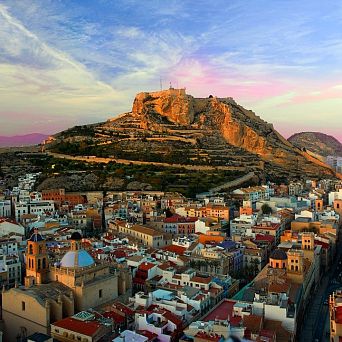
Santa Bárbara Castle in Alicante
Although it is not part of the official Vinalopo 9 Castles route, we recommend visiting Santa Bárbara Castle, as it is the historic fortification closest to Hotel Servigroup Montiboli.
This imposing rocky mass rises 167 meters above sea level and has become a major icon of the city of Alicante.
Its origins date back to the 9th century; it was declared a Historic-Artistic Monument in 1961 and currently holds the status of an Asset of Cultural Interest.
A route to discover the interior of Alicante
The Vinalopo Castles Route offers a journey through a part of the province that differs greatly from the most familiar image of Alicante.
Over a stretch of some 100 kilometres, we encounter everything from massive strongholds like the one in Villena to castles perched atop towering crags—such as the one in Sax—as well as palaces like the one in Elda and unique complexes like La Mola in Novelda.
Yet they all share one thing in common: they remain an integral part of the landscape of the towns and cities found along the Vinalopo.
Frequently Asked Questions about the route
What is the Vinalopo Castles Route? It is a cultural and historical tour through the interior of the province of Alicante, Spain, connecting ancient medieval fortresses.
Can it be done in a single day? It is not recommended. Although the total distance is between 75 and 100 kilometres, the ideal approach is to split the trip over several days.
What is the origin of these fortresses? They are of Andalusi origin and, during the Middle Ages, served as a defensive line and a border for the Kingdom of Valencia.